Reproducible serving study
DeepSeek-V4-Flash on AMD ROCm
vLLM compatibility, long-context validation, and 8K top-k sweep evidence from a correctness-first AMD GPU baseline.
ROCm
vLLM
AITER / PyTorch fallback
2K / 8K / 32K needle retrieval
8K index_topk sweep

Run summary
A compact view of the gates that were actually validated in the AMD ROCm DSW run.
Service gate
HTTP 200
vLLM OpenAI API server exposed
/v1/models successfully.Short completion
Paris, 13.540s
Stable short-answer sanity check with no garbling.
Best 8K point
index_topk=2048
TTFT 80.313s, effective prefill 101.914 tok/s.
Key results
| Gate | Result | Notes |
|---|---|---|
| 2K needle retrieval | PASS, 53.376s | Secret token was recovered from the long prompt. |
| 8K needle retrieval | PASS, 151.976s | The 8K semantic gate remained stable. |
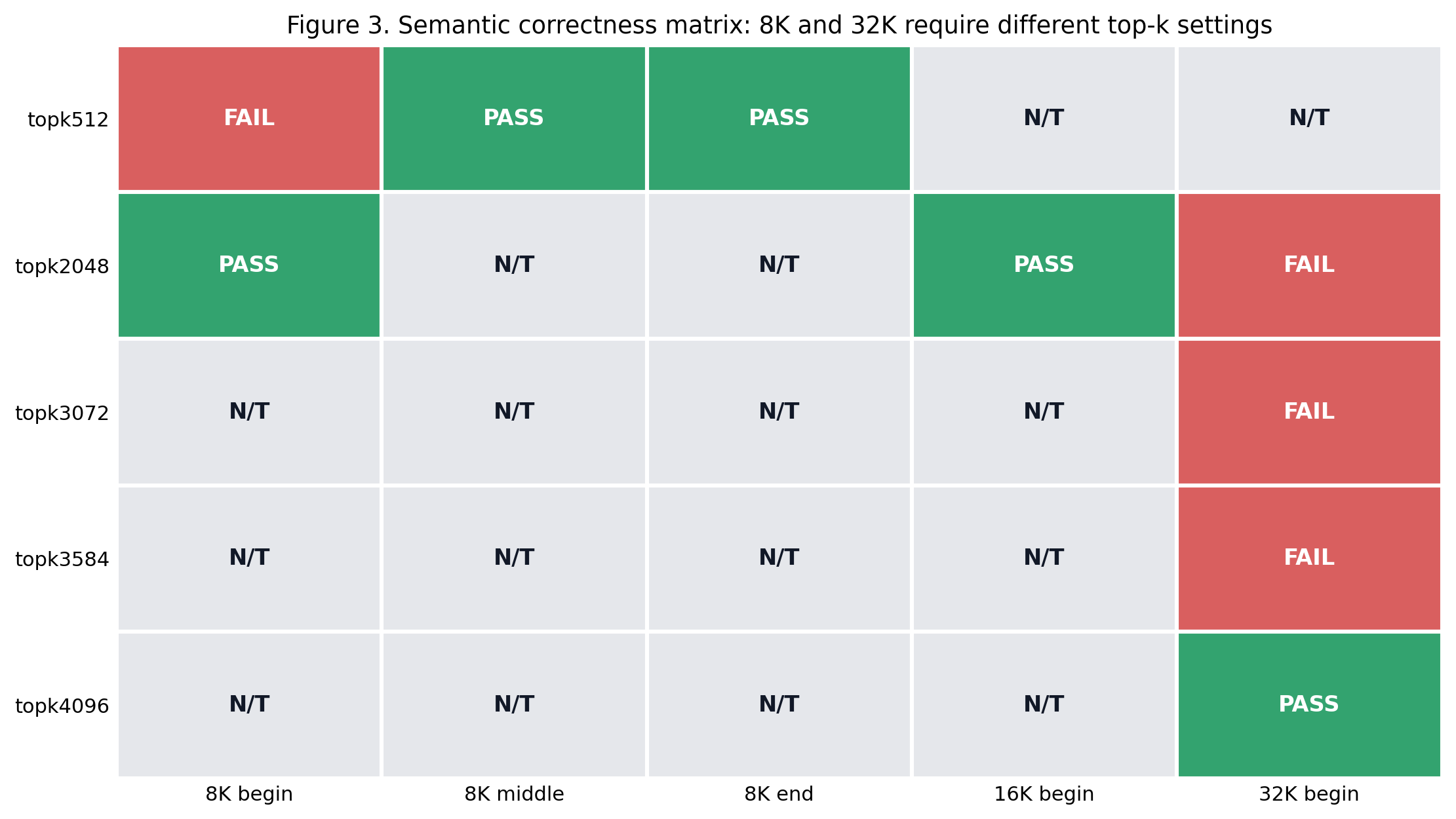
| 32K needle retrieval | PASS at index_topk=4096, 497.470s | This was the verified 32K begin-position correctness point. |
| 8K top-k sweep | 2048 best for this probe | Lower TTFT than the 4096 baseline, but not the 32K correctness setting. |
This Space is correctness-first and fallback-heavy. It is a reproducible
research baseline, not a claim of production-grade high-throughput serving.
Evidence
The figures below mirror the evidence set used in the writeup and publication draft.




Reproducibility notes
Included here
- English cover and evidence figures.
- Static publication page and writeup links.
- Small artifacts that help others replay the baseline.
Excluded on purpose
- Model weights.
- Large runtime caches.
- Anything that can be re-downloaded more cleanly than preserved.